


To achieve perfection, WLTR requires the materials and site to be prepped. It starts by laying bricks on a pre-prepared first course, which sets the foundation for flawless brickwork. Precision begins with the first step, and WLTR ensures every layer that follows is impeccable.


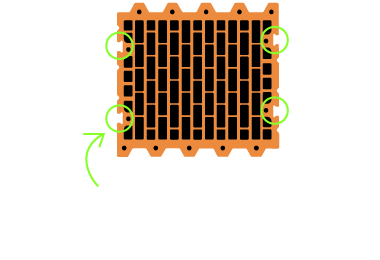
The masonry robot works primarily with the innovative Porotherm bricks of the Robot Ready series. Compared to standard Porotherm bricks, they feature special grooves on the front that the robot uses to grip and lay the bricks. In terms of thermal insulation, load-bearing capacity, strength, acoustic properties and fire resistance, Robot Ready bricks do not differ from conventional bricks. The range of bricks and masonry units that can be processed by WLTR is continuously expanding, with additional materials and product types to become available in the future.
Show Robot Ready bricks
Hide Robot Ready bricks
Precise and consistent bonding is essential in masonry. With WLTR, two proven methods are applied, depending on structural and project-specific requirements.
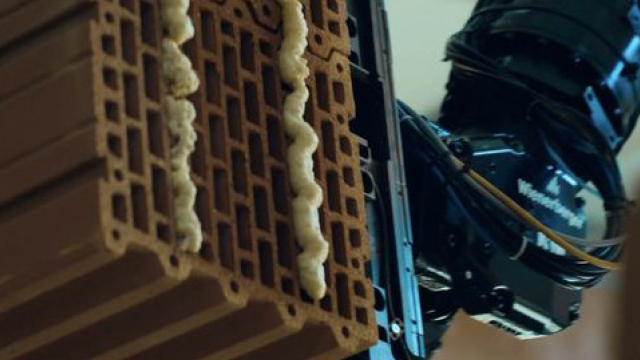
A fast and clean bonding method automatically applied by the masonry robot by spraying PU foam. It reduces material usage while increasing construction efficiency on site.
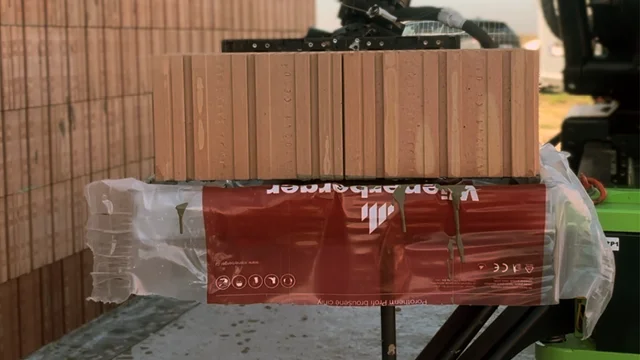
For structures with higher structural load requirements, WLTR can also work with thin-bed mortar, applied by dipping bricks into prepared mortar. This combines robotic precision with established masonry techniques.
While projects don’t need to be designed using the BIM method, it’s highly advantageous. WLTR’s software is fully compatible with BIM, allowing seamless integration and enabling future advancements in robot functionality through BIM-driven project development.
WLTR excels at constructing long, straight walls with minimal openings, making it ideal for tasks such as internal and external load-bearing walls, infill walls and partition structures, as well as infill or partition structures of:


(hospitals, schools, shopping centers, sports arenas, etc.)


